Check engine light on: what to do
The check engine light means the car's OBD system has found a problem that can affect emissions. What you should do next depends mainly on whether the light is steady or blinking.
What the light means
OBD2 monitors components that can affect emissions. When it detects a malfunction it turns on a warning light, usually shown as "Check Engine", "Service Engine Soon" or an engine symbol, and stores a trouble code that a scanner can read.
A steady light does not mean the car will stop running, but the fault can waste fuel, affect how the car drives or lead to more expensive repairs if it is ignored. It is worth checking even if the car feels normal.
Blinking light: reduce driving now
A blinking light indicates a more serious problem, such as a misfire, that could damage the catalytic converter. Minimize driving, avoid high speeds and heavy loads such as towing, and have the car checked as soon as possible.
Steady light: get it checked soon
A steady light is less urgent, but have the car checked soon. Most manufacturers advise servicing as soon as conveniently possible.
Check the gas cap
A loose or missing gas cap is a common cause. When you reach your destination, make sure it is not loose or missing, and always turn the engine off when refueling. If the cap was the cause, the light generally goes off on its own within a few trips. If it stays on after a few short trips, have the car checked.
Read the code yourself
With an ELM327 adapter and OBD Master Pro you can read the code in a minute or two:
- Plug the adapter into the OBD2 port, generally under the dashboard on the driver's side.
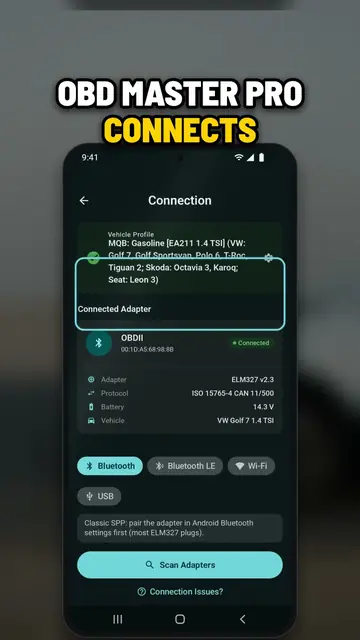
- Switch the ignition on and connect from the app's Connection screen.
- Open the fault codes screen and note every code, plus the freeze frame data.
- Look each code up. Our trouble code guides explain the most common ones.
A code tells you which self test failed, not which part to replace, so use it as the starting point for diagnosis.
After the repair
Clearing codes turns the light off, but it does not fix anything, and the light returns if the fault is still there. Clearing also resets the readiness monitors, so drive normally for about a week before an emissions inspection.
When to see a mechanic
- The light is blinking.
- The light stays on after you checked the gas cap and drove a few trips.
- The car runs rough, loses power, overheats or smells of fuel.
- You are not comfortable doing the repair yourself.
Watch a short video
Videos load from YouTube (privacy-enhanced mode) only after you press play.
Try it on your own car
OBD Master Pro turns your Android phone and a generic ELM327 adapter into a code reader: read and clear codes, view freeze frame and live data, and check emissions readiness.

Keep reading
All OBD2 guides · OBD2 by car brand · OBD2 trouble code guides
Sources
- California Air Resources Board (CARB): On-Board Diagnostic II (OBD II) Systems fact sheet
- U.S. EPA: Do you drive a 1996 or newer vehicle? (consumer information on the check engine light)
- U.S. EPA: What to do with the Check Engine Light (EPA420-F-00-041)
- California Bureau of Automotive Repair: Smog Check Program FAQ
- Clemson University Vehicular Electronics Laboratory: On-Board Diagnostic Systems
- U.S. Code of Federal Regulations, 40 CFR 86.1806-05, On-board diagnostics (govinfo.gov)
- OBD Master Pro on Google Play (app features, supported connections and protocols)
Published . General information only. Details generally vary by model, year and market, so always follow the owner's manual and service information for your vehicle.