P0456: Evaporative Emission System Leak Detected (Very Small Leak)
During a self test of the fuel vapor (EVAP) system, the engine computer found a very small leak, often in the range of a pinhole.
What does P0456 mean?
The EVAP system traps fuel vapor from the tank in a charcoal canister and later burns it in the engine. To check for leaks, the ECM seals the system and watches the pressure or vacuum. If it decays faster than expected, it reports a leak. P0456 is the very small leak version of this test.
Many manufacturers describe a very small leak as roughly equal to a hole of about 0.020 inch (0.5 mm), although the exact threshold and test method vary by vehicle.
The test only runs under specific conditions such as fuel level, temperature and time since the engine was last run, so it can take days of normal driving for the code to set again or for the system to confirm a repair.
Common symptoms
- Check engine light on
- Usually no change in how the car drives
- Occasionally a faint fuel smell near the car
- Failed inspection in areas that check OBD readiness and codes
Common causes
The causes below are the ones commonly seen with P0456. The actual cause can vary by vehicle, engine and mileage, so treat this list as a starting point, not a diagnosis.
- A gas cap that is loose, worn or has a damaged seal
- A leak at the filler neck
- A sticking or leaking purge valve or vent valve
- Cracked or loose EVAP hoses
- A leaking charcoal canister or fuel tank seal
- A faulty leak detection pump or pressure sensor on some vehicles
What to check with a scanner
- Start with the gas cap: check the seal for cracks, make sure it clicks, and use a correct replacement if it is damaged.
- Clear the code with OBD Master Pro after a repair, then use the emissions readiness screen to see when the EVAP monitor has run again.
- If the code comes back, a smoke test is the usual way to find a very small leak. Most shops can do this.
- Note any other EVAP codes, such as P0455 or vent and purge circuit codes, which can point to a specific part.
How to read and clear P0456 with OBD Master Pro
- Plug in your adapter. Connect a generic ELM327 (or ELM329) OBD2 adapter to the diagnostic port, usually under the dashboard on the driver's side. Bluetooth Classic, Bluetooth LE, Wi-Fi and USB OTG adapters are supported.
- Switch the ignition on. Turn the key to ON or start the engine, depending on your car.
- Connect in OBD Master Pro. Open the app, go to Connection and pick your adapter. Classic Bluetooth adapters connect from the Bluetooth tab, Bluetooth LE adapters from the BLE tab with no pairing needed. Use the generic OBD2 / EOBD profile or your car's brand profile.
- Read the codes. Open the fault codes screen to see stored, pending and permanent codes. Confirm P0456 is listed and note any other codes, since they often explain the cause.
- Check the details. Look at freeze frame data, Live data and, where your car supports it, Mode 06 test results (see the checks above).
- Fix, then clear. After the repair, clear the codes to turn off the check engine light. Clearing also resets the emissions readiness monitors, so drive normally and check the readiness screen before any inspection. Permanent codes cannot be erased with a scan tool; they clear on their own once the car's self test passes.
Tip: you can also look up P0456 and other codes in the app's DTC search without connecting to a car. If your adapter will not connect, use Connection > Share connection log and email it to support. Many cheap ELM327 clones only handle basic engine OBD2, which is all you need for P0456.
Watch a short video
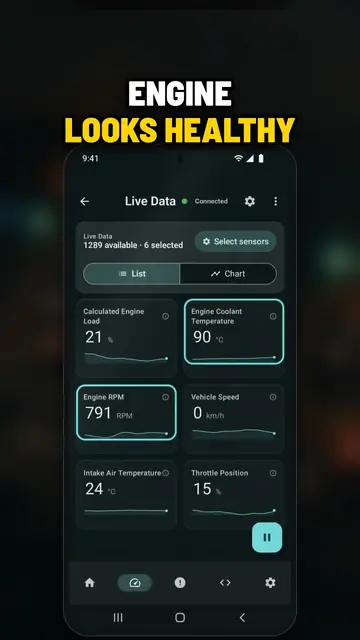
Videos load from YouTube (privacy-enhanced mode) only after you press play.
When to see a mechanic
Get professional help if any of these apply:
- The code returns after checking or replacing the gas cap
- You smell fuel strongly or see a leak
- You need to pass an inspection soon
- Several EVAP codes are stored together
If you are unsure, a qualified technician can confirm the cause with tests such as smoke testing, pressure testing or scope readings. Clearing a code does not repair the fault.
Brand notes
Patterns below come from published manufacturer service information. They do not mean every vehicle of that brand has this problem, and a bulletin only applies to the vehicles it lists.
Toyota (key off EVAP systems)
A Toyota service bulletin for vehicles with key off EVAP systems describes how technicians split the system into the tank side (fuel tank, gas cap and filler neck) and the canister side (canister, purge line and purge valve) to find the leak behind P0456, P0455 and P0441. On these systems the EVAP check runs after the engine is switched off, so a repair may not be confirmed until the car has sat for a while.
Source: Vehicle Service Pros: Toyota EVAP DTCs bulletin (August 2012)
P0456 FAQ
Is P0456 serious?
It is usually not a safety issue and the car normally drives the same. It does mean fuel vapor can escape, and it can cause a failed emissions inspection.
Can a gas cap cause P0456?
Yes. A loose cap or a worn seal is a common cause and an inexpensive first check, but it is not the only possible cause.
How long after fixing it will the code stay off?
The EVAP leak test needs specific conditions, so it can take several days of normal driving before the monitor completes. Check the readiness status in the app to see when it has run.
What is the difference between P0456, P0442 and P0455?
They are the same test with different leak sizes. P0456 is a very small leak, P0442 is a small leak and P0455 is a large leak.
Check P0456 on your own car
OBD Master Pro turns your Android phone and a generic ELM327 adapter into a code reader: read and clear codes, view freeze frame and live data, and check emissions readiness.

Sources
- SAE J2012: Diagnostic Trouble Code Definitions (standard code titles)
- Vehicle Service Pros: Toyota EVAP DTCs bulletin (August 2012)
- Maryland Department of the Environment, RepairCare (May 2018): top DTCs on vehicles failing emissions tests
Published . This guide is general information for generic SAE codes. Always follow the service information for your specific vehicle.